Construction Material Quantity and Cost Guide
Last updated 2026-10-28
These are indicative planning estimates, not a contractor quotation. Actual costs depend on site conditions, design, location, material specifications, labour rates and local approvals.
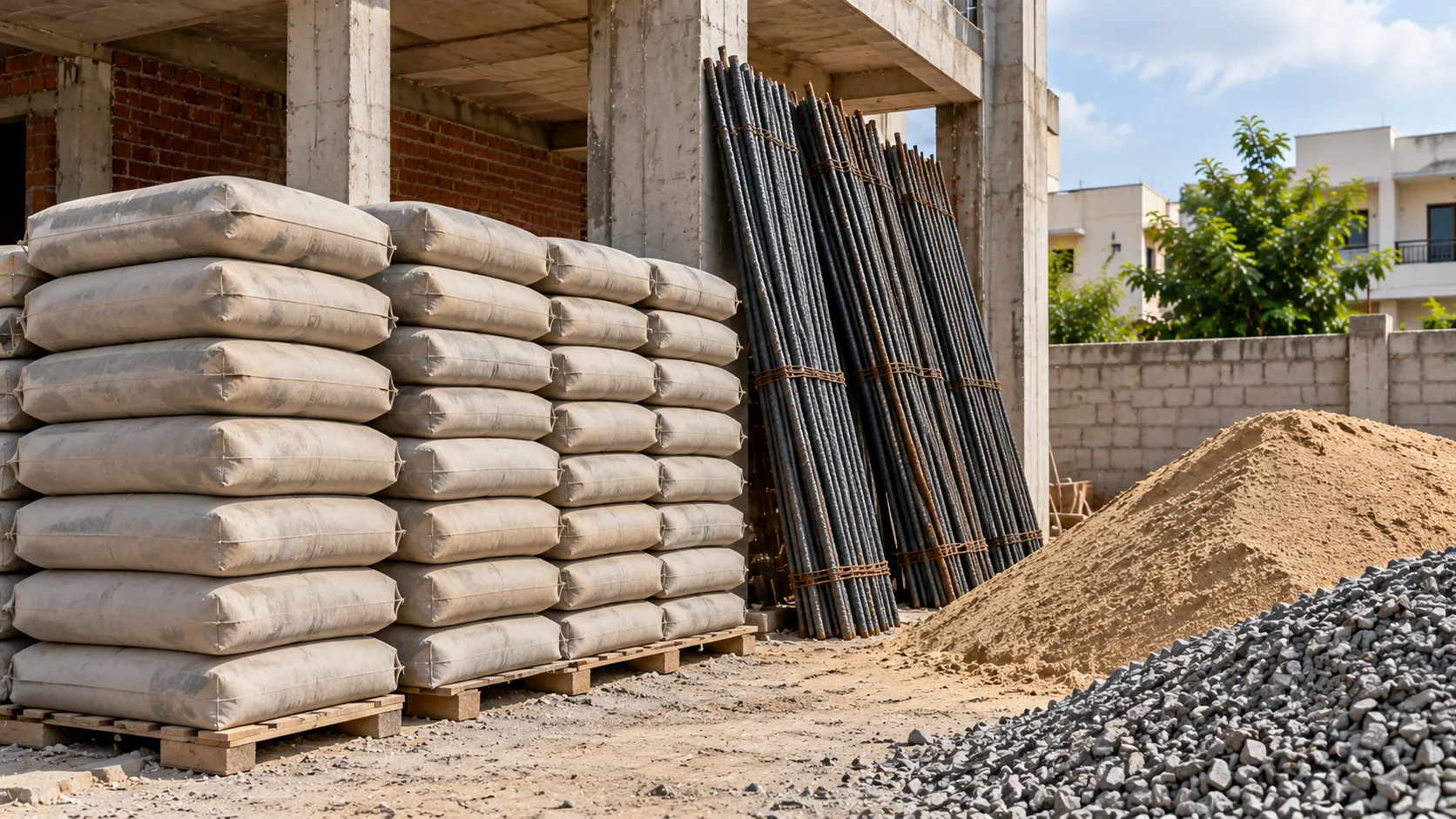
Illustrative 3D visualisation, not an architectural design.
Rule-of-thumb quantities help you sanity-check a quotation or plan cash flow. They are not a substitute for a structural design and bill of quantities.
Planning ranges used on this site
For RCC framed construction, per sq ft of built-up area:
| Material | Typical planning range |
|---|---|
| Cement | 0.38 to 0.45 bags (50 kg) |
| Steel (TMT) | 3.0 to 4.0 kg |
| Sand | 1.5 to 2.0 cu ft |
| Aggregate | 1.2 to 1.5 cu ft |
These are common rule-of-thumb ranges that vary with design, number of floors, soil and construction method. For 1,200 sq ft this gives roughly 456 to 540 bags of cement and 3,600 to 4,800 kg of steel.
Turning quantities into cost
Multiply quantity by your local supplier’s current price. The material cost calculator does this and lets you edit every price. Prices change often by city, brand and season, so use fresh quotes rather than any fixed number.
Using this safely
- Compare your contractor’s stated quantities against these ranges. A large difference deserves a question, not an accusation; there may be a good reason.
- Buy in stages to avoid storing cement for long periods.
- Insist on written specifications for steel grade and cement type.
- Remember bricks, tiles, wood, paint, plumbing and electrical items are not covered here.
Read next: how to prepare a construction budget.